College Admissions Counselors: The Young and The Restless

The “Young and the Restless” is not only the title of one of the longest running daytime television soap operas but is also an apt way to describe college admissions counselors.

This crucial population of professionals is young, averaging around 26 years old. This group is also restless, responsible for recruiting and selecting an impressive group of incoming freshmen. They are also human, so keeping their attention and yielding a positive reaction is imperative for an applicant’s future.

Admissions counselors have demanding jobs and work long hours. In addition to reviewing waves of college applications from the months of November to April, most travel many months visiting high schools, conducting student interviews, and attending college fairs.

How can a college applicant work this oversaturated situation to his or her advantage? Submit a personal essay that stands out. Convey a sense of yourself and your view of the world that is interesting to the reader. Your ideas do not need to be earth-shattering revelations, in fact, readers connect more with relatable details. In a pile of lackluster applications with forgettable features, your essay can make a lasting impression with meaningful messages.

Before crafting your essay, take some time to be introspective.  Create character sketches of you and others who are close to you.  Remember and write down cinematic moments in your life, no matter how small or seemingly insignificant.  Add impact through dialogue and word choice. Direct a movie in your head and play it out on paper.  Your admissions counselors, although young and restless, could be a captive audience.

How can you help make the job of admissions counselors easier? By making their decisions easier. Whether or not to admit you as a student in their freshman class is their decision.  Make it easy for them to decide YES.

Color Samples and the College Search

While gazing at the wall of color samples at the paint store, I became overwhelmed by choices. I took a deep breath and stepped back. After gaining a broader perspective, I realized that the assortment was arranged in a meaningful manner by theme and category. Within its order, I could prioritize my color preferences.

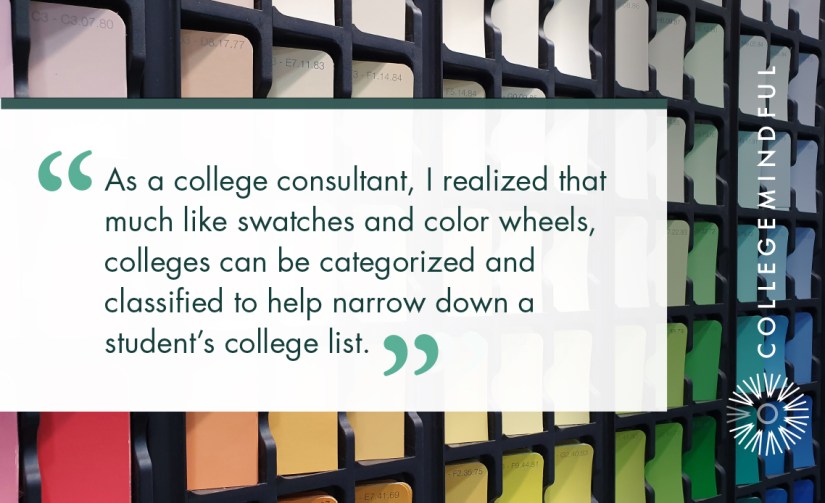
As a college consultant, I realized that much like swatches and color wheels, colleges can be categorized and classified to help narrow down a student’s college list. Through the process of taste, compatibility, and affordability, a top ten list of colleges would emerge.

Students have unique tastes which need satisfying. Enrollment figures, class size, school spirit, campus location, course offerings, and education philosophies are parts of the puzzle that form a college’s culture. Exploring colleges through their websites and campus visits will help to confirm or deny your instincts.

High school academic tracks, honorary awards, class grades, standardized test scores, and extracurricular activities formulate a rubric that dictates compatibility. A three-tier classification of reach, target, and safety schools ensures a well-balanced and realistic list of college choices based on an applicant’s past academic performance and notable accomplishments.

Affordability, although a less romantic approach to finding a college match, is a necessary equalizer. Students should not pursue potential schools that are cost prohibitive. The net price calculator is an online tool that can generate an approximation of your predicted estimated family contribution based on basic financial information such as family income, assets, household size, and debt.

Once a heartfelt and thoughtful list is compiled, college-bound students can become goal-oriented and purpose-driven. They can undergo self-discovery and learn self-promotion to generate strong college applications for optimal acceptance rates. They can add color to their lives by painting pictures of their futures: earning college admissions and attending their chosen colleges.